Thursday, November 8, 2012

Are you thirsty for water?


                Odds are you’re viewing this blog on a computer.  Have you ever stopped to consider what was required to make your computer?  It takes a lot of water to produce a computer, so much that you could do 70 loads of laundry with the amount used on your computer.  Ten gallons alone is required to make the small processor that does all the work on your computer.  Your processor works as the “brain” of your computer that uses instructions from a program to perform a certain task.   The processor, therefore, requires lots of water to make relative to the size.   As everyone wants the latest gadget, our water usage has increased over time.
                We use water daily, from brushing our teeth and cooking to using computers and driving cars.  Our demand for products such as food, clothing, and electronics uses vast amounts of water to produce these for consumption.  With the recent drought in Nebraska and global water shortages, Americans need to understand how to reduce their water usage both personally and economically such as factory water usage.
                Five unexpected high water use products:
  • The average car uses enough water in production of the steel and plastic used to make the car to fill 800 bathtubs or about 40,000 gallons.
  • A plastic water bottle uses 1.85 gallons of water to make, more water than the bottle actually contains.
  • A pound of beef needs 4,000-18,000 gallons of water. Most of the water goes to growing food and water for the cow.
  • A 100% cotton shirt and jeans uses a combined total of 2,500 gallons of water to grow the cotton and dye the fabric.
  • Each latte consumed uses 53 gallons of water to grow the coffee beans, make the plastic lid, and produce the cup and sleeve.

Americans need to be more aware of their water usage if we are to reduce national and global water usage.  In 2012, the global population passes seven billion people and continues to grow. Competition for fresh water will also increase, especially in drier areas of the world.  America, one of the most wasteful countries in the world, must take the initiative to reduce water usage for a greener future.

Four innovative possibilities to lower water usage:
  • Purchase a water efficient washer rated by Energy Star
  •  Use reusable water bottles to prevent water from being wasted on plastic bottles
  •  Behavioral changes to our daily routines, such as shorter showers and turning off the water when brushing.  Simple behavior changes by people can have a huge impact on reducing water usage.
  •  Mulching a garden retains moisture better and keeps soil cooler during the summer.


Resources
U.S Geological Survey Water School http://ga.water.usgs.gov/edu/

Photo Credits
engineerguy.com

Celebrate Earth Day or Die


We need Earth Day to remind us that for now and into the immediate future, this Earth is the thing that sustains our lives. Mankind at this point in our evolution cannot live anywhere else in our solar system. That could change some day, but for now we need to try as hard as we can to care for the Earth that we all share to give us time and means to explore other worlds.

Need some persuasion? Consider the many threats that are good reasons why we need Earth Day.

Deforestation is a problem rapidly affecting areas like Africa, Central and South America. Not only does this mean less trees, less cleansing oxygen, and the displacement of the wildlife that live within the forests, but deforestation is also a large contributor to global warming and enhanced greenhouse effect. Removing trees also leads to much drier climates, as trees extract groundwater to release into the air.

Pollution is the introduction of harmful contaminants into air, water or soil. These contaminants can have dire effects on entire ecosystems, making life more difficult for humans, plants and animals. Children and the elderly are particularly susceptible to the health effects from these toxins. In many cases, exposure to pollution has a cumulative effect on the body.

Loss of biodiversity is an important threat because each species has a role in planet, and as they dwindle or become extinct, this points to a much larger problem. For example, the decline of the bee population has a direct effect on both the environment and food production, with their instinctual role of pollination. A major factor of saving the earth is to also protecting its inhabitants.

Any of these environmental problems could really harm the Earth. People need to start realizing the significance of Earth Day. You can celebrate Earth Day by outdoor performances, where individuals or groups perform acts of service to earth. These can include planting trees, picking up roadside rubbish, conducting various programs for recycling and conservation, and using recyclable containers for snacks and lunches. Other activities include encouraging people to sign petitions to governments calling for stronger or immediate action to stop global warming and to reverse environmental destruction.

By doing any of these activities makes a huge difference to the Earth. I mean why wouldn’t you want to help out Mother Nature? Look what she does for you. We are provided with a world to live on, water to drink, and food to eat. Our whole lives depend on Earth. What’s the harm in one day a year of doing an outdoor activity benefiting the Earth?

Tuesday, November 6, 2012

Pulling the Plug on the Panda?


At the forefront of conservation efforts around the world, the giant panda has been a major flagship species. The World Wildlife Fund (WWF) has used the giant panda as their logo since their founding in 1961 and the panda has attracted a lot of the publics’ attention due to its charismatic and fluffy disposition. Although being rare, some naturalists have said the pandas should be left alone to face their extinction.

            In a controversial interview with Radio Times magazine, Chris Packham, a respectable naturalist and presenter of Autumnwatch on BBC, stated the money spent on the giant panda should be used on “stronger” species.

            "Here's a species that, of its own accord, has gone down an evolutionary cul-de-sac. It's not a strong species. Unfortunately it's big and cute and it's a symbol of the WWF, and we pour millions of pounds into panda conservation. I reckon we should pull the plug. Let them go, with a degree of dignity," said Packham.

            Packham considers the giant panda as a weak species for many reasons: the panda has chosen a rather unreliable food source with low nutritional value. The panda is also susceptible to several diseases and has developed a sporadic breeding style that is incredibly hard to replicate in captivity. Millions are being spent on an animal that seems to be ecologically doomed.

Since one of the major causes of extinction is habitat loss, Packham suggests purchasing rainforests and biodiversity hotspots would be a more effective use of the millions spent on panda conservation. Instead of singular campaigns focusing on a single species like Save the Pandas; Save the Rainforests would be better.

            Of course, this idea spurred some backlash. Dr. Mark Wright, a conservation scientist at WWF, states that the panda has adapted to life in a narrowly defined habitat. There are many other species on the planet that have adapted to living in specific environments as well. Why does the giant panda not deserve to be conserved? Wright argues that if it were not for human populations encroaching on and destroying the panda’s habitats they would survive just fine.

            The giant panda also shares its environment with several other species in need of preservation; for example the red panda, the endangered golden monkey, and many endemic bird species. So, preserving the habitat for this extremely popular animal will in turn help the not as well-known animal species.

            Since conservation has limited resources to tackle all the species on the planet, should we only focus on flagship species that people find attractive, and then hope they protect the “unpopular” species in return? Or should we think more broadly and use campaigns focusing on whole ecosystems? The conservation efforts of the panda aren’t likely to change due to their overwhelming popularity, but this topic does bring up some good questions regarding worldwide conservation practices and whether or not they should change.

Water Quality Sustainability


Have you ever wondered how we can just turn on faucet and have crystal clear water, healthy enough for drinking? Lincoln hasn’t always had this luxury… and it just doesn’t happen by magic. There is actually a very complex system behind it that has been developed over many years.

The sources of our drinking water come from surface water, including lakes, rivers, streams, ponds, reservoirs, springs, and wells. This water needs to be filtered and treated. Nature has done a lot of the work for us by filtering the water by perculating through the soil, down into the aquifer; however, iron and manganese content are still high. To remove these elements our water is treated at treatment plants, before being sent to our homes. The old process that has been used in the 1930’s is still used today. This includes: aeration, chlorination, detention and filtration. An exact of amount of chlorine is added to reservoirs and held for up to two hours. The undesired particles then get filtered through the sand and gravel, which gets cleaned every 5 days. Another process uses the strong oxidizer and disinfectant known as ozone. After the water undergoes these processes, the disinfectant called chloramine is added to prevent bacteria growth in the city’s pipes. Fluoride is also added to prevent tooth decay. In order to prevent other contaminants, Lincoln has a cross connection control program. This employs backflow prevention devices in case of a main break that causes a sudden drop in pressure, or caused by heavy usage. Plumbing systems need to be inspected every five years as preventative maintenance. Water services are owned and maintained by the property owner. In order to deliver water to these owners, $1.7 million is spent for electricity. Another $1.35 million is spent on the electricity and diesel fuel to pump that water to Lincoln. The city covers more than 90 square miles, and has 1,243 miles of water mains, 10,562 fire hydrants and 24,993 valves. 105 broken mains were repaired in 2011. The water delivered to our homes can vary from 41 degrees to 77 degrees. The average use per person came out to be 124 gallons every day in 2011.

The Safe Drinking Water act requires that Lincoln Water System issues a report, describing the quality of our drinking water. This report helps us understand and raise awareness about the quality and conservation of our water. All of this information can be found on InterLinc. By going to www.lincoln.ne.gov/city/pworks/water, you find fun facts, general information, informative videos, water distribution information, water system master plans, and water quality data. All of this is managed by public works, and when it comes to the conservation of our water it is monitored and decided by the mayor. All of Lincoln Water Systems operators and state certified, and must be documented to comply with state and federal laws. Their hours are around the clock, same as any repair man that works on the mains.

Wednesday, October 31, 2012

EHD in Nebraska


The whitetail deer (Odocoileus virginianus) population in Nebraska has been under attack this year. An Epizootic Hemorrhagic Disease (EHD) outbreak has taken a heavy toll, killing an estimated 5818 individuals.

Such a high number of mortalities is uncommon for EHD in Nebraska. The graph below shows that in past years the death toll rarely exceeds 100 individuals. According to Greg Wagner, Public Information Officer for Nebraska Game and Parks, last year's mild winter coupled with dry conditions this summer may be to blame. In previous years, a harsh winter would kill of the biting midge or fly responsible for spreading the disease.

Deer begin to show signs of being infected about seven days after being bitten by an infected midge. Symptoms of the disease include: loss of appetite and fear of man, fever, and rapid respiration rates. Deer killed by EHD are often times found in or near bodies of water. This can be attributed to the fever caused by the disease, infected deer often lie in water to reduce their internal body temperatures. The deer eventually die from extensive internal bleeding.

With bow season currently running and rifle season right around the corner, hunters may be worried that they will not see as many deer in their area. In some areas of the state this may be true, but the graph below, provided by Wagner, shows that not all counties have been affected equally by the disease.

The NebraskaLand magazine's website reports that the disease cannot be transmitted to humans or pets. The meat from infected deer is safe to eat and will not pass on EHD to humans. If you should happen to come across a deer that you believe to have been killed by EHD, the Nebraska Game and Parks Commission is asking that you contact their offices so they can further determine the extent of the disease.

Tuesday, October 30, 2012

Fires Destroying Land and Hunting Opportunities
By: Nick Jenkins


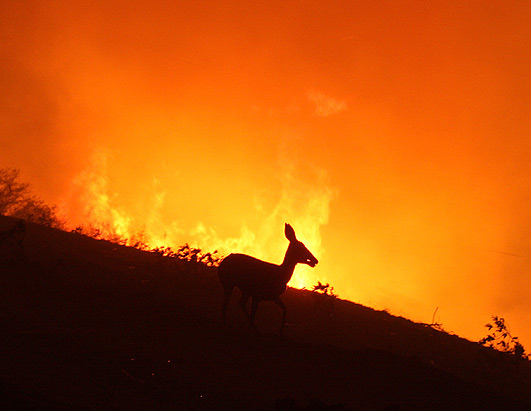
The recent drought in Nebraska has created wild fires throughout the state.  Fires are starting from things as simple as a cigarette bud to hot exhaust pipes on combines.  With the entire state being so dry, the fires have not been easy to put out.

"Nine fires from mid-June to mid-October burned 271,514 acres, the equivalent of 424 square miles, in places from the Niobrara River Valley east of Valentine to Hay Springs, Chadron, Crookston, Crawford and Hemingford in the west (Kearneyhub.com)".  

There are a couple things that would help prevent wildfires while out hunting.  The first of these is walking the majority of your hunt.  Mapping out your hunt a head of time will limit your driving to prevent your vehicle from starting wildfires.

The second of these things to prevent fires is picking up your shell casings after shooting your weapon.  A shell or cartridge that has just been projected from a shotgun or rifle is very hot.  By picking them up with your gloves, and placing them in your pocket, wildfires can be prevented.

Droughts are something that come and go regularly here in Nebraska.  This does not mean that we have to postpone the activities that we enjoy.  If the proper and careful steps are taken, an activity such as hunting can still be enjoyed during these harsh, drought conditions.

Solar Roadways

By: Ty Cope
Macintosh HD:Users:tycope:Desktop:solar_road_brusaw_smart_grid.jpeg
Solar roadways are a revolutionary idea that is being researched by Scott Brusaw, they are based on the need to find an alternative to asphalt. This is being achieved by making a new type of roadway made up of thousands of little solar panels and led screens. The idea is to make a road that will pay for itself by generating electricity and sending it back to the consumers for use. Based on some of his research if we replaced the existing roads in the U.S. we could make over triple the power that is currently being consumed with a type of renewable energy.
            The really remarkable aspect of the roadways is that they are being made of glass. This glass will have all of the same physical properties of asphalt but with the added feature of solar panels and LED lights. The LED lights are able to spell out words that would generally be put onto signs. The scientist have also looked into making smaller panels to be used in crosswalks that could sense when people are crossing the road and warn drivers of their presence.
Macintosh HD:Users:tycope:Desktop:imgres.jpeg 

http://www.youtube.com/watch?v=Ep4L18zOEYI